How to budget with irregular income: a baseline, a buffer and one daily number

Short answer
To budget with irregular income, plan around a baseline instead of your best month: a conservative share, such as 75%, of your average monthly take-home over the last 3 to 6 months. Let every payment land in a holding account, pay yourself the baseline as a fixed monthly salary, take fixed costs and savings out of it, and divide what is left by 30 for a daily spending number. Good months refill the holding account; bad months draw on it.
When your income changes from month to month, budget on a baseline, not on what you hope to earn. Average your take-home over the last three to six months and plan on about 75% of it. Every payment goes into a separate holding account, and once a month you pay yourself the baseline as a fixed "salary". Fixed costs and savings come out of that salary first; what is left becomes a daily spending number. In a good month the extra stays in the holding account. In a bad month the holding account pays your salary anyway. To check the daily figure for your own numbers, use the daily budget calculator.
Why is budgeting on irregular income hard?
Standard budgeting advice starts from "your monthly income", as if it were one number. For freelancers, gig workers, people on commission and seasonal workers, it isn't. Two things vary: how much comes in, and when it arrives. One invoice paid three weeks late can turn a good month into a tight one.
The usual trap is spending like the good months. A $5,000 month feels like the new normal, spending rises to match, and the next $1,500 month lands on a budget that can't absorb it. The fix is to separate earning from spending: income goes into one place, and you pay yourself a steady amount out of it.
How do I work out a baseline income?
- List your take-home income for the last 3 to 6 months. Count money on the date it reached your account, not the date you invoiced. Use what is left after platform fees and, if no tax is taken out of your payments, after the share you put aside for tax. A tax office or accountant can tell you how much.
- Take the average. Add the months and divide by how many there are. Six months smooths out more; three months reacts faster when your work changes.
- Plan on a conservative share of it. 75% of the average is a sensible starting point. It leaves room for a weak month without making the budget too tight.
If you have no buffer yet, or your income has been falling, look at the lowest month in the period and use it when it is lower than 75% of the average. With less than three months of history, count only work that is confirmed.
My Money's budget assessment uses the same rule: when you choose irregular income, it budgets on 75% of the recent average.
Where should the money go when it arrives?
Open a separate account (a basic savings account is enough) and send every payment there: client invoices, platform payouts, commission, cash jobs. This is your holding account, sometimes called a buffer. Your everyday account receives only one thing: your salary.
- Start with a cushion if you can. One month of salary in the holding account before you begin means a slow first month doesn't break the system.
- Set a target size. One to three months of salary. The bigger your swings, the bigger the target.
- Sweep the excess. When the account ends a month above target, move the extra to savings or a goal. Otherwise it quietly becomes a second spending account.
How do I pay myself a fixed salary?
Pick a day, such as the 1st, and move the baseline from the holding account to your everyday account every month, whatever you earned. Like a paycheck, the amount doesn't change because a client paid early or late. Then budget it like any regular income:
- Fixed costs first. Rent, utilities, phone, internet, insurance, loan payments, subscriptions and a monthly share of annual costs. These are due however the month goes.
- Savings next. A fixed amount, even a small one. Extra money from good months reaches savings through the sweep, so this amount can stay modest.
- What's left is spending money. Divide it by 30 for a daily number. The daily budget method explains carry-over and what belongs in the daily number.
A daily figure such as $30 stays the same whether a client paid on the 2nd or the 28th, and it shows your pace while the month is still happening.
Worked example: six months of freelance income
Setting the baseline and the daily number
A freelance designer's take-home income, after platform fees and the tax set-aside, averaged $3,200 a month over the last six months. Baseline: 75% × $3,200 = $2,400 a month, paid as a salary on the 1st.
From the salary: rent and bills $1,300, savings $200. $2,400 − $1,300 − $200 = $900 of spending money, and $900 ÷ 30 = $30 a day.
The holding account starts with $2,400, one month of salary. The target is two months, $4,800; anything above that at month end moves to savings.
All figures are examples, not typical earnings.
| Month | Income in | Salary out | Moved to savings | Holding account at month end |
|---|---|---|---|---|
| Start | – | – | – | $2,400 |
| Jan | $4,200 | $2,400 | $0 | $4,200 |
| Feb | $1,800 | $2,400 | $0 | $3,600 |
| Mar | $2,600 | $2,400 | $0 | $3,800 |
| Apr | $5,300 | $2,400 | $1,900 | $4,800 |
| May | $1,500 | $2,400 | $0 | $3,900 |
| Jun | $3,800 | $2,400 | $500 | $4,800 |
| Total | $19,200 | $14,400 | $2,400 | – |
Income ranged from $1,500 to $5,300, yet the salary never changed, and neither did the $30 a day. February and May fell short of the salary by $600 and $900; the holding account covered both. April and June pushed it past the $4,800 target, so $1,900 and $500 went to savings.
The check: $2,400 at the start + $19,200 in − $14,400 in salary − $2,400 swept = $4,800 at the end. Add the $200 a month saved from the salary ($1,200) and six months produced $3,600 of savings, while the cushion doubled. Income averaged $3,200 again, so at the next review the baseline stays at $2,400.
What should I do in a bad month?
- Keep paying the salary from the holding account. That is what it is for.
- If the account can't cover it, pay yourself less and pause savings first. In the example, a $2,200 salary with savings paused still leaves $900, so the daily number stays at $30. A $1,900 salary with savings paused leaves $600, and the daily number drops to $20.
- Adjust early. If a payment slips mid-month, divide the spending money left by the days left, counting today.
- Don't fill the gap with a credit card. Borrowing to keep the daily number unchanged pushes the problem into next month, often with interest.
- Chase what you're owed. Sometimes a bad month is only a late month. Follow up on unpaid invoices before cutting deeper.
- Review the baseline every three months, using the latest months. If weak months keep coming, lower the salary before the holding account runs dry.
Does this work for gig, commission and seasonal income?
Yes. Only the way you find the baseline changes, and students with a part-time job can use it too.
| Income type | How to find the baseline |
|---|---|
| Freelance and contract work | Average the last 3–6 months by the date money arrived, then take 75%. |
| Gig work and part-time shifts | Convert weekly pay to monthly: weekly average × 52 ÷ 12. $600 a week is $2,600 a month; 75% of that is $1,950. |
| Base pay plus commission or tips | Budget on the base pay and send commission or tips to the holding account. If the base can't cover fixed costs, add a cautious share of your average commission. |
| Seasonal work | Use the last 12 months: annual take-home ÷ 12, then a conservative share. The holding account needs a larger target to carry you through the off-season. |
The student budget guide works through an example with part-time pay.
How does My Money handle irregular income?
My Money is a free iPhone app that turns a monthly budget into one number: how much you can still spend today. It suits the salary approach, because the daily number comes from a steady monthly amount, not from what arrived this week.
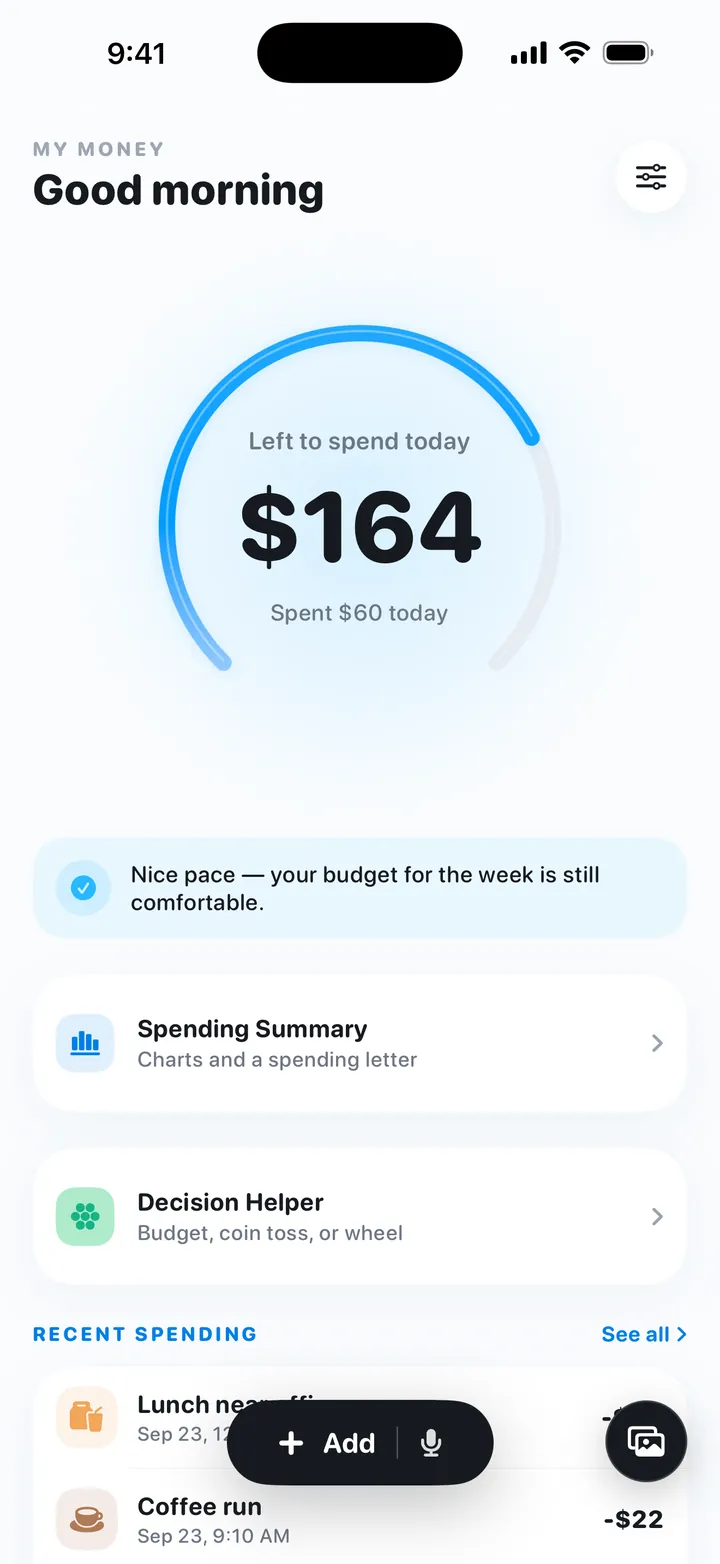
- Two ways to set up. Enter a monthly spending amount directly ($900 in the example), or take the budget assessment and choose irregular income: My Money budgets on 75% of the recent average, subtracts fixed costs, everyday living costs and your savings goal, and offers plans such as Saver (save about 30% of income), Balanced (about 20%) and Flexible (about 10%). The daily reference is roughly the pocket money left ÷ 30. It all runs on the phone with fixed rules, not AI.
- Carry-over. Spend less than the daily amount and the difference carries into the following days; spend more and the coming days get less. Carry-over is capped at five days' worth.
- Re-assess when income changes. You can change the plan or redo the assessment any time in Settings, which fits a three-month review.
- Logging income. Income can be logged, and logged income offsets spending. If your budget already comes from a fixed salary, logging each client payment as income would count that money twice, so keep those payments in your holding-account records.
Try My Money on iPhone
Your monthly budget as one number: what you can still spend today. Log by typing, voice or a bill screenshot. Free, no account, no ads.
FAQ
How do you budget when your income varies every month?
Work out your average monthly take-home over the last 3 to 6 months and budget on a conservative share of it, for example 75%. Pay yourself that amount as a fixed salary from a separate holding account, and let good months top the account up so it can cover the bad ones.
How much should a freelancer keep in a buffer?
Aim for one to three months of your baseline salary in the holding account; the more your income swings, the bigger the buffer. Once it reaches your target, move anything above it to savings at the end of the month.
What should I do in a month when I earn very little?
Keep paying yourself the usual salary from the holding account. If the account cannot cover it, pay yourself less, pause savings first, lower the daily number to match, and avoid covering everyday spending with a credit card.
Should my baseline be my lowest month or my average?
Either can work. About 75% of the recent average is a sensible middle ground. If you have no buffer yet or your income has been falling, use your lowest recent month when it is lower than that.
Can My Money budget irregular income?
Yes. In the budget assessment you can choose irregular income, and My Money budgets on 75% of the recent average, then works out a daily reference after fixed costs, living costs and savings. It is iPhone only and does not connect to bank accounts, so you log entries yourself.
Try My Money on iPhone
Your monthly budget as one number: what you can still spend today. Log by typing, voice or a bill screenshot. Free, no account, no ads.
Keep reading
 The daily budget method: turn your monthly budget into one number for todayTurn a monthly budget into a daily spending limit: take-home pay minus bills and savings, divided by days. Carry-over rules and a worked example.
 The 50/30/20 rule: a worked example, its limits, and how to pair it with a daily budgetThe 50/30/20 rule splits take-home pay into 50% needs, 30% wants and 20% savings. Worked example, when it fails, and how to turn wants into a daily budget.Daily budget calculatorFree daily budget calculator. Enter take-home pay, fixed costs and savings to see how much you can spend each month and each day, plus tomorrow after carry-over.