The 50/30/20 rule: a worked example, its limits, and how to pair it with a daily budget

Short answer
The 50/30/20 rule splits monthly take-home pay into 50% for needs, 30% for wants and 20% for savings and extra debt payments; on $4,000 that is $2,000, $1,200 and $800. It sets the split but does not show how fast you are spending, which is what a daily budget does. Use both: let 50/30/20 size the three parts, then take fixed costs out of the wants part and divide the rest by 30 to get one number to spend each day.
The 50/30/20 rule divides take-home pay into three parts: half for needs, 30% for wants and 20% for savings. It is a quick way to check whether your month is balanced. What it doesn't tell you is whether, on the 12th, you are spending the wants money too fast. A daily budget does that. So use the rule to set the split, take fixed costs out of the wants part, and divide what is left by 30. On $4,000 a month that comes to $35 a day for eating out, shopping and fun. The daily budget calculator does the division for your own numbers.
What is the 50/30/20 rule?
The 50/30/20 rule is a simple way to split monthly take-home pay. It is commonly attributed to Elizabeth Warren and Amelia Warren Tyagi, who described it in their 2005 book All Your Worth.
| Part | Share | What goes in |
|---|---|---|
| Needs | 50% | Rent or mortgage, utilities, groceries, insurance, basic transport, minimum loan payments, childcare |
| Wants | 30% | Eating out, coffee, shopping, entertainment, hobbies, travel, subscriptions, upgrades beyond the basics |
| Savings and debt | 20% | Emergency fund, retirement, other savings goals, loan payments above the minimum |
A simple test for a need: would you still have to pay it if your income stopped next month? Rent, yes. A streaming subscription, no. Groceries are a need; eating out is a want. When one bill is both, such as a phone plan pricier than you need, the basic version is the need and the rest is a want.
The percentages apply to take-home pay, what reaches your account after tax, not to your gross salary.
50/30/20 budget example on $4,000 a month
Example: $4,000 a month after tax
50% for needs = $2,000. 30% for wants = $1,200. 20% for savings = $800. $2,000 + $1,200 + $800 = $4,000.
| Part | Item | Amount |
|---|---|---|
| Needs | Rent | $1,300 |
| Needs | Utilities, phone, internet | $200 |
| Needs | Insurance | $100 |
| Needs | Transit pass | $100 |
| Needs | Groceries | $300 |
| Wants | Gym | $50 |
| Wants | Streaming and apps | $40 |
| Wants | Holiday fund | $60 |
| Wants | Day-to-day wants: eating out, coffee, shopping, going out | $1,050 |
| Savings | Emergency fund | $300 |
| Savings | Retirement | $300 |
| Savings | Extra loan payment | $200 |
Each part adds up. Needs: $1,300 + $200 + $100 + $100 + $300 = $2,000. Wants: $50 + $40 + $60 + $1,050 = $1,200. Savings: $300 + $300 + $200 = $800. These are example numbers; your own rent and bills decide how well the split fits.
How do I turn the 30% into a daily budget?
The wants part has the same problem as any monthly total: $1,200 feels generous on the 3rd and thin on the 24th. So split it once more.
- Take out fixed wants. Subscriptions, the gym, a monthly holiday set-aside: things that cost the same every month. Here that is $150, leaving $1,050.
- Divide by 30. $1,050 ÷ 30 = $35 a day for eating out, coffee, shopping and going out.
- Decide about groceries. They are a need, but you buy them often and the amount varies. If you would rather watch one number for all day-to-day spending, add them: ($1,050 + $300) ÷ 30 = $45 a day.
- Let the days balance each other. On $35 a day, spend $20 today and tomorrow has $50; spend $60 and tomorrow has $10. The daily budget method covers carry-over in detail.
Needs and savings stay monthly: rent is paid once, and savings move on payday. Only the flexible money gets a daily number, so the number never collapses because rent went out.
50/30/20 vs a daily budget: what's the difference?
| 50/30/20 rule | Daily budget | |
|---|---|---|
| Question it answers | How should I split my income? | How much can I spend today? |
| Time frame | Monthly | Daily, with carry-over |
| What you watch | Three monthly totals | One running number for flexible spending |
| Good at | Setting a balanced split and a savings rate | Showing your pace mid-month, before overspending builds up |
| Weak spot | Says nothing about pace; overspending shows up at month end | Doesn't set your savings rate or fixed costs; you decide those first |
| Ongoing effort | Sorting costs into three groups | Logging each purchase |
They cover each other's gaps. The rule on its own is easy to set up and easy to drift from. A daily number on its own can be set too high, because nothing made you decide savings first.
When doesn't 50/30/20 fit, and how do I adapt it?
The rule is a starting point, not a test. It fits best when income is steady and housing costs are moderate. Common cases where it doesn't:
- High-rent cities. Housing alone can take close to half of take-home pay. Start from your real needs figure and trim wants before savings.
- Low income. If needs take 70% or more, 30% for wants isn't there. Save something, even 5–10%, and give needs what they actually cost.
- Students. An allowance, loan or part-time pay often just covers rent and food. Skip the percentages: take out fixed costs and a small buffer, then split the rest by day. See the student budget guide.
- Irregular income. 50% of which month? Set a conservative baseline first, then apply the split to it. See how to budget with irregular income.
- High-interest debt. A 50/20/30 split, with the extra going to the debt until it is paid off, can make more sense.
| Situation | Split | Take-home | Needs | Wants | Savings / debt | Daily wants |
|---|---|---|---|---|---|---|
| High-rent city | 60/25/15 | $4,000 | $2,400 | $1,000 | $600 | $30 (after $100 fixed wants) |
| Low income | 70/20/10 | $2,500 | $1,750 | $500 | $250 | $15 (after $50 fixed wants) |
| High-interest debt | 50/20/30 | $4,000 | $2,000 | $800 | $1,200 | $25 (after $50 fixed wants) |
Whatever the split, make it add up to 100% and write down the dollar amounts. A split you can follow beats a textbook one you drop in week two.
How does My Money fit with 50/30/20?
My Money is a free iPhone app built around the daily half of this approach. It turns a monthly budget into one number: how much you can still spend today.
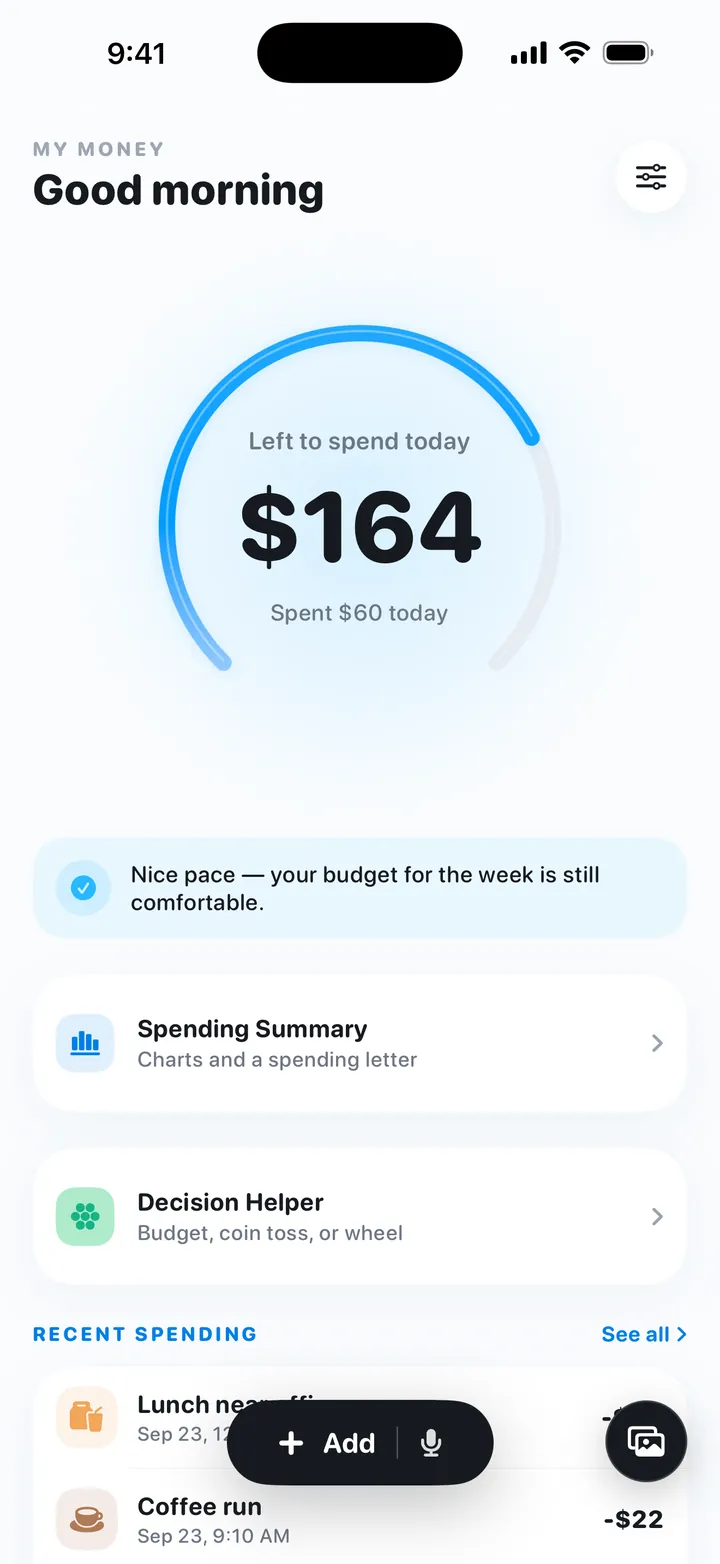
- Enter your wants money directly. On first launch you can enter a monthly spending amount and start: $1,050 in the example, or $1,350 with groceries. Rent and savings are handled outside the app, and you log day-to-day spending.
- Or let the budget assessment set the split. It asks for income, fixed costs, everyday living costs, a savings goal and a spending style. It subtracts fixed and living costs (roughly your needs) and savings, and uses the pocket money left ÷ 30 as the daily reference, which is close to the wants part of 50/30/20. The Balanced plan saves about 20% of income, the same share as the rule; Saver saves about 30% and Flexible about 10%. A Goal plan appears when your own savings goal is above 20%, and an Essentials plan when essential costs leave very little room, which is where 50/30/20 stops fitting. It all runs on the phone with fixed rules, not AI.
- Carry-over with a cap. Spend less and the difference carries into the following days; spend more and the coming days get less. Carry-over is capped at five days' worth.
- Check the split afterwards. The spending summary covers the last 30 days: total spent, per-day average, a category donut chart and a ranked category list, so you can see whether eating out or shopping is taking more than you planned.
Try My Money on iPhone
Your monthly budget as one number: what you can still spend today. Log by typing, voice or a bill screenshot. Free, no account, no ads.
FAQ
What is the 50/30/20 rule?
A budgeting guideline that splits take-home pay into three parts: 50% for needs such as rent, bills and groceries, 30% for wants such as eating out and hobbies, and 20% for savings and extra debt payments. It is commonly attributed to Elizabeth Warren and Amelia Warren Tyagi's 2005 book All Your Worth.
What is a 50/30/20 budget example?
On $4,000 a month after tax: $2,000 for needs, $1,200 for wants and $800 for savings. After $150 of fixed wants such as a gym and streaming, $1,050 is left for day-to-day wants, which is $35 a day over 30 days.
Is the 50/30/20 rule based on gross or net income?
Net, meaning take-home pay after tax. Using gross pay makes every part look bigger than the money you actually receive.
What if my needs are more than 50% of my income?
Use your real needs figure and adjust the other two parts, for example 60/25/15 or 70/20/10. Keep some savings, even a small share, and look at your largest fixed cost, usually housing, when the lease or contract comes up.
Is a daily budget better than the 50/30/20 rule?
They answer different questions. The 50/30/20 rule decides how much goes to needs, wants and savings each month; a daily budget shows how much of the flexible money you can spend today. Used together they cover both the split and the pace.
Try My Money on iPhone
Your monthly budget as one number: what you can still spend today. Log by typing, voice or a bill screenshot. Free, no account, no ads.
Keep reading
 The daily budget method: turn your monthly budget into one number for todayTurn a monthly budget into a daily spending limit: take-home pay minus bills and savings, divided by days. Carry-over rules and a worked example.
 How to budget with irregular income: a baseline, a buffer and one daily numberBudget on 75% of your 3–6-month average income, keep the rest in a buffer, pay yourself a fixed salary and spend from a daily number. Worked example.
 How to budget as a college student and make your allowance last the monthBudget a student allowance: add up money in, take out fixed costs and a buffer, split the rest into a daily number, then log it and check weekly.