The daily budget method: turn your monthly budget into one number for today
Short answer
A daily budget is the amount you can spend today on everyday things, worked out from your monthly budget. Subtract fixed bills and savings from your monthly take-home pay, then divide what is left by the days in the month: $900 over 30 days is $30 a day. Unspent money carries into the next days and overspending shrinks them, so you see your pace every day instead of at the end of the month.
A daily budget splits this month's money for everyday spending into one number per day. You work it out once: take-home pay, minus fixed bills, minus savings, divided by the days in the month. After that, each day you only need to know how much is left for today. Spend less and the difference rolls forward. Spend more and the next few days shrink. The daily budget calculator does the arithmetic for you.
What is a daily budget?
A daily budget, also called a daily spending limit or daily allowance, is what you can spend today on flexible, day-to-day things: food, groceries, coffee, taxis, going out, small purchases. Rent, bills and savings are dealt with before the number is worked out.
It doesn't replace a monthly budget. It is a way of reading one.
Why does a daily number help?
A monthly budget often gets checked only at the end of the month, when it is too late to change anything. A figure like "$900 for everything else" is also hard to feel on an ordinary Tuesday. It looks generous on the 3rd and worrying on the 24th.
A daily number shows your pace while the month is still happening. If you have $30 a day and spent $55 yesterday, today should be a light day, and you didn't have to add up the month to know it. This matters most for discretionary spending, where each purchase is small and none of them feels like the problem.
How much should I spend per day?
There is no right amount for everyone. It depends on your income, fixed costs and savings goal. Work it out in five steps:
- Start with monthly take-home pay. Use what actually arrives after tax. If your income varies, use a cautious figure below your recent average.
- Subtract fixed bills. Rent, utilities, phone, internet, insurance, loan payments, a commute pass, subscriptions: anything that costs about the same every month.
- Subtract irregular and annual costs. Add up insurance renewals, annual subscriptions, car costs, birthdays and holidays for the year, divide by 12 and set that aside each month.
- Subtract savings. Decide what you will save before deciding what you will spend. What is left is your spending money.
- Divide by the number of days. Spending money ÷ days in the month = daily budget.
30 days or the actual number? Dividing by 30 gives a round figure that works for any month. The actual days are more exact: $900 is $29.03 a day in a 31-day month and $32.14 in a 28-day February. The difference is small, so pick one and stick with it.
Starting mid-month? Take the spending money actually left and divide by the days remaining, counting today. Starting on September 16 with $420 left means 15 days (the 16th through the 30th), or $28 a day.

What belongs in the daily number, and what doesn't?
The daily number covers spending you decide day by day. Costs you can't change on a given day stay out. Otherwise the day rent is due looks like a disaster and every other day looks generous.
| In the daily number | Set aside separately |
|---|---|
| Groceries and eating out | Rent or mortgage |
| Coffee, snacks, delivery | Utilities, phone, internet |
| Taxis and one-off transport | Insurance and loan payments |
| Clothes and household bits | Annual subscriptions and renewals |
| Entertainment and nights out | Travel and holiday gifts |
| Treats and impulse buys | Savings |
Groceries are a need, but they still belong in the daily number: you buy them often, the amount varies, and small choices there add up.
What happens when I spend more or less than my daily budget?
Real days are never equal. The method works because the days are linked:
- Underspending carries forward. Spend $22 on a $30 day and tomorrow starts at $38.
- Overspending shrinks the following days. Spend $45 on a $30 day and tomorrow starts at $15. After a very expensive day, you can spread the difference over several days instead.
- Carry-over needs a cap. Without one, a quiet week becomes one very large "today", which makes a big impulse buy easy. About five days' worth ($150 on a $30 budget) keeps a buffer without inviting a splurge. On paper, anything above the cap can go to savings.
Worked example: $30 a day for five days
Setting up the number
Take-home pay is $3,200 a month. Rent is $1,200, fixed bills (utilities, phone, internet, insurance, transit pass) are $350, annual costs set aside are $100, and savings are $650.
$3,200 − $1,200 − $350 − $100 − $650 = $900 of spending money. $900 ÷ 30 = $30 a day.
"Available" is the daily $30 plus whatever carried in from the day before.
| Day | Daily amount | Carried in | Available | Spent | Carries forward |
|---|---|---|---|---|---|
| Mon | $30 | $0 | $30 | $22 | +$8 |
| Tue | $30 | +$8 | $38 | $15 | +$23 |
| Wed | $30 | +$23 | $53 | $61 | −$8 |
| Thu | $30 | −$8 | $22 | $18 | +$4 |
| Fri | $30 | +$4 | $34 | $26 | +$8 |
Over five days the budget was $150 and spending was $142 ($22 + $15 + $61 + $18 + $26), leaving $8 to carry into Saturday. Wednesday's $61 dinner didn't break anything: two light days covered most of it, and Thursday absorbed the last $8. On a monthly-only budget, that dinner would be one line in a total you might not check for weeks.
How does it compare with the 50/30/20 rule and the envelope method?
| Method | How it works | Good at | Weak spot |
|---|---|---|---|
| Daily budget | Spending money ÷ days, with carry-over | Showing your pace mid-month; one number to watch | Doesn't set your savings rate; you decide that first |
| 50/30/20 rule | Take-home pay split 50% needs, 30% wants, 20% savings | A quick big-picture split | Monthly totals only; 50% for needs can be tight where rent is high |
| Envelope method | Cash or sub-accounts per category; stop when one is empty | Firm limits per category | Many pots to manage; moving money between them gets fiddly |
They combine well. Use 50/30/20, or your own split, to decide what goes to bills and savings, then turn the flexible part into a daily number. A daily budget is really one envelope for everything discretionary, topped up a little every day.
What are common daily budget mistakes?
- Forgetting irregular and annual expenses. An insurance renewal or a wedding gift that wasn't set aside lands on one day and wipes out a week of budget. List them once and divide by 12.
- Setting it too tight. A number you break on day two is hard to stick with. Start from what you spend now, then trim a little each month.
- Not logging small purchases. The number is only as accurate as your records. Coffee, snacks and delivery fees are easy to skip, and they are why the method exists.
- Treating carry-over as extra money. A $120 carry-over isn't a bonus. It is this month's money you haven't spent yet. Keep it as a buffer, or move what's left to savings at month end.
How does My Money handle the daily budget method?
My Money is a free iPhone app built around this method. It turns a monthly budget into one number: how much you can still spend today. Log a purchase and the number goes down.
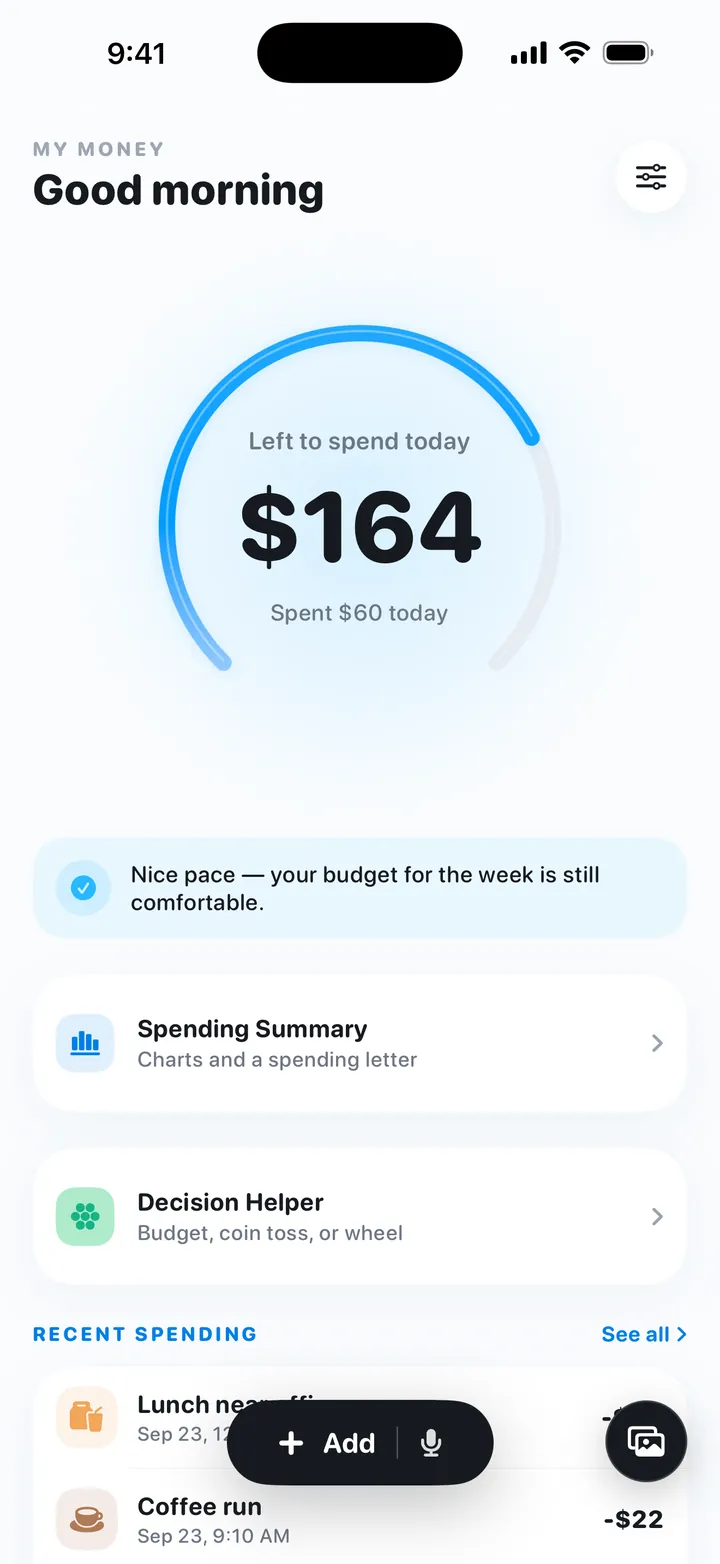
Setup on first launch takes about a minute. You can enter a monthly spending amount directly, or take the budget assessment: income (monthly take-home, annual pre-tax or irregular), fixed costs such as rent and commute, everyday living costs, a savings goal and a spending style. The assessment works out available money as income minus fixed and living costs, subtracts savings to get pocket money, and uses pocket money ÷ 30 as the daily reference. Irregular income is budgeted at 75% of the recent average. It all runs on the phone with fixed rules, not AI.
You then pick a plan: Saver (save about 30% of income), Balanced (about 20%) or Flexible (about 10%). A Goal plan appears when your own savings goal is above 20%, and an Essentials plan when essential costs leave very little room. You can change the plan or redo the assessment any time in Settings.
Carry-over follows the rules above: spend less than the daily amount and the difference carries into the following days; spend more and the coming days get less. Carry-over is capped at five days' worth of the daily allowance. Income you log offsets spending. To log, type a line such as "Coffee 5" and the amount and category are filled in, use on-device voice input, or pick up to five payment screenshots or receipt photos and review the drafts. More in the guides on the Action Button and screenshot logging.
Try My Money on iPhone
Your monthly budget as one number: what you can still spend today. Log by typing, voice or a bill screenshot. Free, no account, no ads.
FAQ
How much should I spend per day?
There is no universal amount. Take your monthly take-home pay, subtract fixed bills, set-asides for annual costs and savings, then divide what is left by the days in the month. For example, $900 of spending money over 30 days is $30 a day.
Should a daily budget include rent and bills?
No. Rent, utilities, phone, insurance and annual costs are paid from money set aside separately. The daily number covers day-to-day spending such as food, groceries, coffee, taxis and small purchases.
What happens if I go over my daily budget?
The overspend comes out of the following days, so they get a smaller number. One expensive day does not ruin the month as long as the next few days are lighter.
Should unspent money carry over to the next day?
Yes, carrying it forward rewards cheaper days. A cap, for example five days' worth of your daily amount, stops a quiet week from turning into one oversized day. My Money caps carry-over at five days' worth.
Do I need an app to keep a daily budget?
No. A notebook or spreadsheet works if you record every purchase and update the running balance each day. An app such as My Money does the carry-over math for you and shows what is left to spend today.
Try My Money on iPhone
Your monthly budget as one number: what you can still spend today. Log by typing, voice or a bill screenshot. Free, no account, no ads.
Keep reading
 The 50/30/20 rule: a worked example, its limits, and how to pair it with a daily budgetThe 50/30/20 rule splits take-home pay into 50% needs, 30% wants and 20% savings. Worked example, when it fails, and how to turn wants into a daily budget.
 How to budget with irregular income: a baseline, a buffer and one daily numberBudget on 75% of your 3–6-month average income, keep the rest in a buffer, pay yourself a fixed salary and spend from a daily number. Worked example.