How to set a daily travel budget and stick to it
Short answer
A daily travel budget is what you can spend on each day of a trip once flights, hotels and anything else booked ahead are paid for. Take the total trip budget, subtract prepaid costs, keep a small buffer and divide the rest by the trip days: $2,000 − $1,360 prepaid − $80 buffer = $560, or $80 a day for 7 days. Money not spent on a quiet day carries forward to a day you want to spend more.
A daily travel budget is what you can spend on each day of a trip after the big costs booked ahead are paid. Start with the total you can afford for the trip. Subtract prepaid costs such as flights, hotels, travel insurance and tickets bought in advance. Keep a small buffer for surprises. Divide the rest by the trip days, counting travel days. That number covers meals, local transport, sights and small purchases, and what you don't spend on a quiet day carries forward to a bigger one.
How much should I budget per day for travel?
There is no single right figure; it depends on where you go and how you travel. Two quick estimates, used together, give a realistic number:
- Top down: what you can afford. Total trip budget, minus prepaid costs, minus a buffer, divided by the days.
- Bottom up: what the destination costs. Price one ordinary day there: three meals, local transport, one paid activity and small extras. Online menus, official transit fares and attraction websites give real prices.
A bottom-up day might look like this: breakfast $10, lunch $15, dinner $25, local transport $8, one museum or tour $15, coffee and snacks $7. That adds up to $80 a day.
If the bottom-up number is higher than the top-down one, the trip doesn't fit yet. Drop a day, choose cheaper lodging, pick fewer paid activities or save for longer. Better to find out at home than on day four.
Which travel costs belong in the daily number?
Split the trip in two. Prepaid costs are settled before you leave. On-trip costs are the choices you make each day while away, and only they go into the daily number.
| Prepaid (settled before you go) | On-trip (the daily number) |
|---|---|
| Flights, trains and buses booked ahead | Meals, coffee and snacks |
| Hotels or rentals paid in advance | Metro, buses and taxis |
| Travel insurance | Entry tickets bought on the day |
| Visa or entry fees | Souvenirs and small shopping |
| Tours and tickets booked in advance | Tips, laundry, a SIM or data top-up bought there |
A hotel you pay at check-in is still a fixed amount, not a daily choice: keep it out of the daily number, but set the money aside before you leave. Rent and bills at home keep running too; they come from your normal monthly budget, not the trip.
How do I calculate a daily travel budget?
- Set the total trip budget. The most you will spend, from savings or money put aside for it.
- Subtract prepaid costs. Add up everything already paid or fixed before departure, including hotels you pay on arrival.
- Keep a buffer. A small amount for surprises (see below).
- Count the days. Include arrival and departure days. They are rarely cheap: airport food, a train into the city, a taxi to the hotel.
- Divide. (Total − prepaid − buffer) ÷ days = your daily travel budget.
How big should the travel buffer be?
A buffer is money kept aside for costs you can't plan: a missed connection, a pharmacy visit, a taxi because the last train has left. A simple size is about one day of on-trip spending, which you already know from the bottom-up estimate. Keep more for a long or remote trip.
The buffer is not for extra shopping; if it pays for souvenirs, it won't be there when something goes wrong. Whatever is left at the end goes back into savings.
How does carry-over help on a trip?
Trip days are uneven: a day of parks and markets might cost $45, a cooking class and a good dinner $140. Carry-over lets both fit:
- Spend less and tomorrow gets more. Spend $50 on an $80 day and tomorrow starts at $110.
- Spend more and tomorrow gets less. Spend $100 on an $80 day and tomorrow starts at $60.
- Save up for the special day. If you know which day will cost more, keep the days before it light and let the difference build.
- Don't borrow from the last day. Spending big early and planning to make it up at the end rarely works; the last day has its own costs: checkout, the airport ride, a meal on the way.
Worked example: a 7-day trip at $80 a day
Setting up the number
The total trip budget is $2,000 for 7 days (6 nights). Prepaid: flights $560, a hotel at $120 a night for 6 nights ($720) and a day tour booked ahead ($80). Prepaid total: $560 + $720 + $80 = $1,360.
On-trip money: $2,000 − $1,360 = $640. Buffer: $80. $640 − $80 = $560, and $560 ÷ 7 = $80 a day.
"Available" is the day's $80 plus whatever carried in from the day before.
| Day | Daily amount | Carried in | Available | Spent | Carries forward |
|---|---|---|---|---|---|
| 1 (arrival) | $80 | $0 | $80 | $95 | −$15 |
| 2 | $80 | −$15 | $65 | $52 | +$13 |
| 3 | $80 | +$13 | $93 | $48 | +$45 |
| 4 | $80 | +$45 | $125 | $61 | +$64 |
| 5 (cooking class) | $80 | +$64 | $144 | $138 | +$6 |
| 6 | $80 | +$6 | $86 | $70 | +$16 |
| 7 (departure) | $80 | +$16 | $96 | $90 | +$6 |
Over 7 days, on-trip spending was $554 ($95 + $52 + $48 + $61 + $138 + $70 + $90) against $560, leaving $6. The $80 buffer was never touched. The whole trip cost $1,360 + $554 = $1,914, which is $86 under the $2,000 plan.
The arrival day went $15 over. Days 2 to 4 were light and built up $64, enough to cover the $58 by which Day 5 went over its $80. The cooking class wasn't a splurge; it was planned.
Which currency should I budget in?
Use one currency for the whole trip. A list that mixes dollar amounts with local prices can't be added up. Two clean options:
- Log in your home currency. Convert each purchase at a rounded rate before you write it down. This works best if the trip is part of your normal monthly budget.
- Log in the local currency. Convert the daily number once instead. At a rate of, say, 1.5 local units to the dollar, $80 a day is 120 a day in local money.
Card payments may post at a slightly different rate, sometimes with a foreign transaction fee; the buffer covers that.
How do I stick to a daily travel budget?
- Log at the moment you pay. Ten seconds at the counter beats rebuilding the day from memory at night.
- Photograph receipts and screenshot payment confirmations. Paper receipts get lost or come in a language you can't read; a photo keeps the amount and time.
- Check the number each evening. Add up the day, see what carries into tomorrow and look at tomorrow's plan. If a big day is coming, you'll know to keep today light.
- Log what you buy with cash, not the withdrawal. Taking $200 from an ATM isn't spending; the meals you pay for with it are. If you'd rather not track every small cash purchase, log the withdrawal instead, but only one of the two, or you count the money twice. ATM fees do count.
- Log only your share of group costs. If you pay for everyone and friends pay you back, record the repayment so your total shows what you really spent.
Can I use My Money for a travel budget?
My Money is a free iPhone app that turns a monthly budget into one number: how much you can still spend today. It has no trip mode or separate trip budget. The budget is monthly: you enter a monthly spending amount or take the budget assessment, and you can change the plan in Settings at any time.
It fits a trip best when the on-trip money is part of that monthly amount, such as a weekend away paid from everyday money. Keep the days before the trip light and the unspent amount carries forward, up to five days' worth of the daily allowance, so the trip days start with more room. Income you log offsets spending, so a friend paying you back for a shared dinner brings the number back up.
For a bigger trip paid from separate savings, every purchase you log still counts against the monthly budget, so the Home number will drop during the trip and the days after it will get less. To keep a record anyway, work out the trip's daily number yourself and compare each day with it in the calendar view, which shows a total for every day.
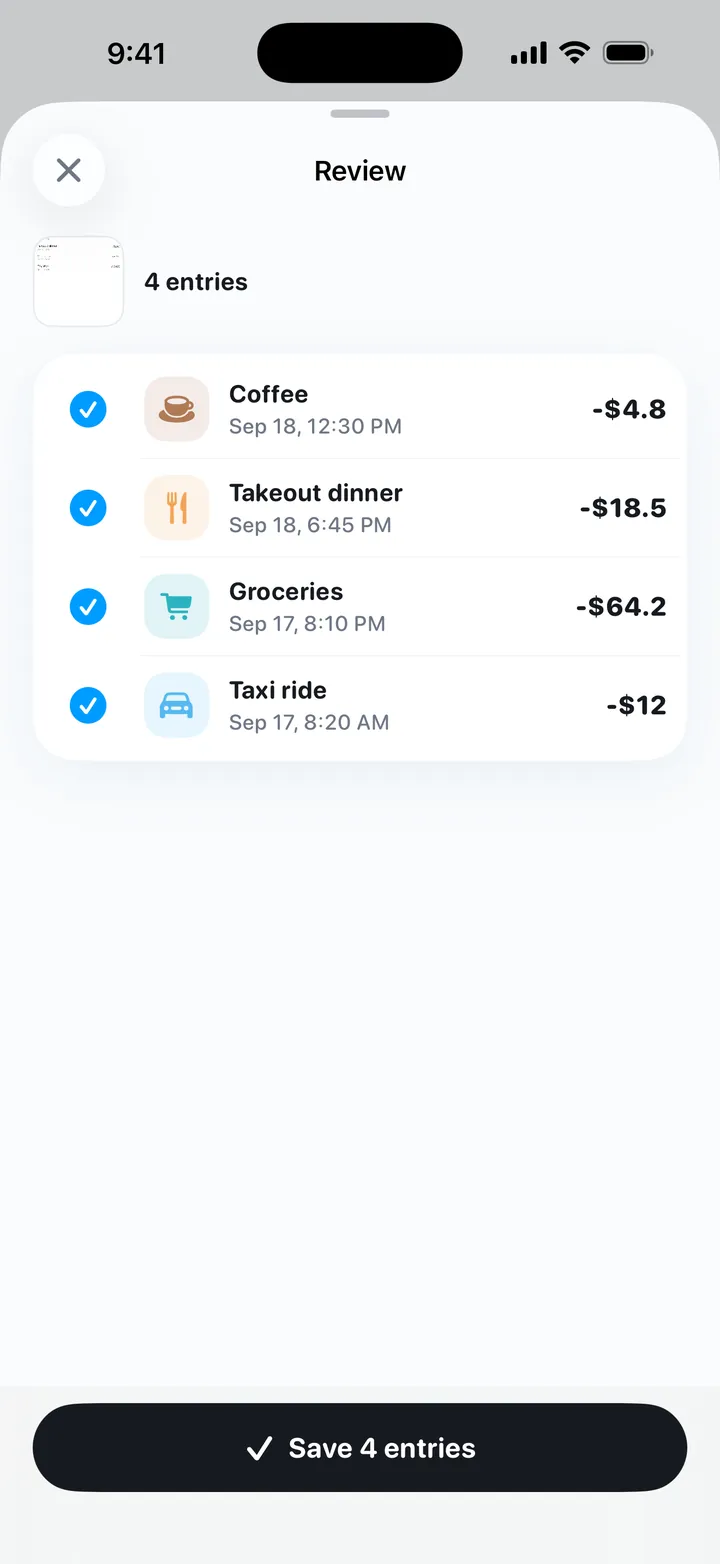
Logging on the move is quick. Type "Taxi home 18" and the amount and category are filled in, or tap the mic and say it; speech recognition runs on the device only, so voice needs on-device support for your language. Siri or a shortcut, including one on the Action Button, can run Quick Log without opening the app. In the evening, pick up to 5 payment screenshots or receipt photos: the text is read on the iPhone, each line becomes a draft you can edit or uncheck, and nothing is saved until you tap save. An evening reminder can prompt the daily check. More in the guide to screenshot expense tracking.
Try My Money on iPhone
Your monthly budget as one number: what you can still spend today. Log by typing, voice or a bill screenshot. Free, no account, no ads.
FAQ
How much should I budget per day for travel?
It depends on the destination and how you travel. Price one ordinary day there (meals, local transport, one paid activity and small extras), then check it against what you can afford: total trip budget minus prepaid costs and a buffer, divided by the number of days.
Should flights and hotels be included in a daily travel budget?
No. Pay for or set aside flights, hotels and anything booked in advance first. The daily number covers what you decide on the trip itself: food, local transport, tickets bought on the day and small purchases.
How big should a travel buffer be?
A simple size is about one day of on-trip spending, more for long or remote trips. Use it for surprises such as a missed connection, a pharmacy visit or a late taxi, not for extra shopping, and return what is left to savings.
Does My Money have a trip or travel mode?
No. My Money's budget is monthly. It fits a trip best when the on-trip money is part of your monthly spending amount, because unspent money carries forward (up to five days' worth), so light days before the trip leave more room for it.
Can My Money convert foreign currency?
No. Amounts are plain numbers with no exchange rates; the English interface shows $ and the Chinese interface shows ¥. Log trip spending in one currency, ideally converted to the currency of your normal budget, so the totals add up.
Try My Money on iPhone
Your monthly budget as one number: what you can still spend today. Log by typing, voice or a bill screenshot. Free, no account, no ads.
Keep reading
 The daily budget method: turn your monthly budget into one number for todayTurn a monthly budget into a daily spending limit: take-home pay minus bills and savings, divided by days. Carry-over rules and a worked example.
 How to turn bill screenshots and receipts into expense entries on iPhoneLog expenses from payment screenshots, bills and receipt photos on iPhone: which images read well, the steps in My Money, accuracy tips and privacy.Daily budget calculatorFree daily budget calculator. Enter take-home pay, fixed costs and savings to see how much you can spend each month and each day, plus tomorrow after carry-over.